
Talk about Faith – AND Politics
Thanks to Diana Butler Bass for sharing these insights in her blog, The Cottage.
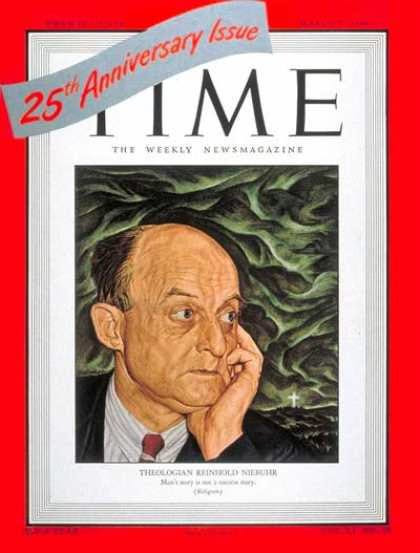
Butler Bass explores the myth (encouraged by right-wing evangelical leaders and pundits) that ‘radical clerical politics’ caused the 1980s (and following) decline in mainline protestant churches. She refutes the myth through reflection on her childhood mainline Methodist upbringing, describing her ‘working-class, non-college educated [Baltimore] neighborhood’ as the ‘trickle-down mainline recipients of the great discussions of the day’ – complete with a framed Time Magazine cover, just outside her Sunday school room, featuring Reinhold Niebhur, considered ‘a kind of Protestant saint of the questions’.
She contrasts her upbringing with that of her friend Tim Whitaker, who grew up – in the 1990s – in an evangelical church, home-schooled, and who attended a church college. He had never heard of ‘the Niebuhr brothers’ and, despite an insatiable curiosity and intellectual vigor, had never experienced a community in which questions were asked.
Bass writes:
It isn’t that Reinhold Niebuhr had all the answers. He didn’t… But Niebuhr represented a tradition – part of that long Christian argument that shaped the imagination of an elementary school girl in a Methodist church in Baltimore. From him, and from… others, I learned that it was good to argue about faith and politics in church. Indeed, it was our birthright.
Ultimately, that’s how Christianity defines politics – a long argument about the life of God and civic life, about the relationship between Theos and polis. It isn’t partisanship or dirty tricks or the horserace or polls or a party or a single issue. Those aren’t politics, even if contemporary people are chuffs on this point.
From a theological perspective, politics is the argument about the nature of community, who counts in community, and our moral responsibility for community. It is an old argument. It existed long before Jesus, long before Rome. It runs through the Hebrew Scriptures. It shape ancient societies. These are questions [at] the heart of human existence, these theological-political questions.
No society avoids them. Except, of course, to their peril.’
How might your congregation become a safe(r) place to engage in difficult discussions?
Keep reading Bass’s post for some ideas.
Read the full post here. [P.S. Be sure to read Miller Williams’ On History and Hope poem at the conclusion of the post. Brilliant and beautiful.]
If/when you’re ready, The Ministry Lab has support.
Start with our Courageous Spaces: Congregations that Listen, Lament, & Repair Toolkit, with tips for facilitator training, Group Norms development, intergenerational conversations, spiritual practices, worship, and more.
For tips and tools to engage particular difficult discussions, see our:
We’ve also worked with the ELCA Truth-Seeking & Truth Telling Initiative in building their Indian Boarding Schools Learning Toolkit, with multi-media resources and contemplative practices. That will be published and available free soon.
Also, coming up: watch for our Graceful Conversations, created with Tammy Walhof, Director of Lutheran Advocacy-Minnesota: a five-part video series to empower facilitation of difficult discussions within the congregation and throughout the community. We hope to have that available by mid-August, 2024.
Blessings as you encourage political and other difficult discussions throughout God’s Beloved Community!

